


John Donne
La Corona (1608)
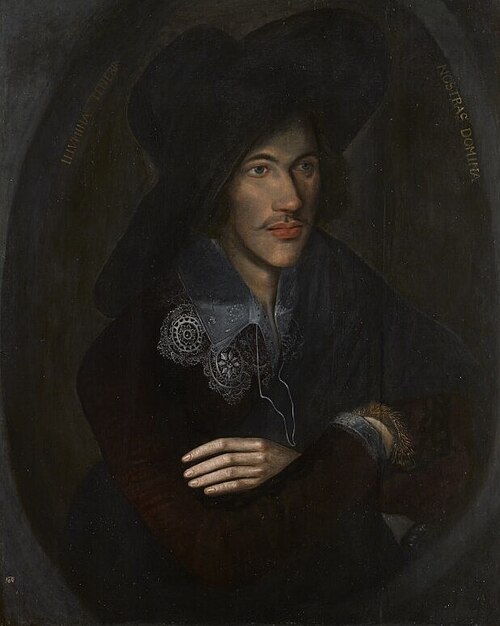
John Donne
The literary journal Gambito de papel has recently published my translation of John Donne’s sonnet cycle “La corona”. This translation represents a personal landmark as a poetry translator. I would like to thank Jerónimo Corregido and the journal’s team for their interest in publishing my work, as well as for their comments and suggestions, which illuminated my translation. What follows is an English translation of the commentary I wrote for the publication:
“La Corona” (thus its original title) is a sequence of seven religious sonnets by English poet John Donne (1571-1631), composed around 1608. These poems are both thematically and formally linked, the last verse of each sonnet being identical to the first of the following sonnet. The cycle comes to a close in like manner between the seventh and the first sonnets.
This form, known as “Crown of sonnets”, had its origins in 15th-century Italian poetry, and had been scarcely used in the English language. Donne’s crown is an extended meditation and prayer on the life of Christ, from its annunciation to his death and resurrection. But it also represents a palette of the human condition in its relationship with God, from the initial melancholy to the joyous promise of perpetual life.
These Baroque poems can be seen as a chiaroscuro, where the contrast of light and darkness, woven in the manner of a crown, comprises circles that end where they began. Thus, for example, Christ’s life is narrated as a life-death-life sequence.
As a devotional work, the poet begins his prayer with a plea (“Deign at my hands”), later becoming an expression of gratitude and returning to the first plea. We can also see the circle of the restoration of body and soul, which, from their original state, become corrupted by sin and return to “that, there, of which and for which ’twas”. All of this shows that Donne used the crown form masterfully. His choice was no mere flaunting of technical command or embellishments: he appealed to the crown in order to fully display the rhetorical potential of these poems.
What about my translation? Let’s begin with the technical aspects. I wished to preserve, in the first place, the exacting rhyme scheme of the original. Then, I chose Spanish alexandrines to replace the iambic pentametres, a widely used solution to translate the archetypal metre of English poetry. This is meant to reasonably provide room to transmit the sense of these compositions, along with Donne’s characteristic philosophical, theological and intellectual depth.
Of course, as in all truly poetical translations that choose to reproduce the form, some slight differences will come up between the two versions. Mind you, I say differences, not losses, for careful reading will also reveal some gains. (Is not every translation, in itself, a gain?) My ideal for poetical translation is that acknowledging said differences will not be reduced to a mere count of gains or losses, instead attempting not only to preserve but to multiply the meaning of a poem.
Truly successful translations, I think, are beyond a gain-loss logic. Rather, the differences between versions may uncover elements that used to be patent and are now latent, and vice versa. There is no loss in preserving, in potency, what used to be present in act; likewise, every “new” element in a translation is justified as long as it actualises something that was present, albeit potentially, in the original. Whether I have achieved that or not in this case will be for readers to judge.
Lastly, why did I translate “La Corona”? I must say that this is a special work for me. John Donne has been by my side from my very first steps in poetry. Reading and translating his poems has been a true school for me throughout the years. With them, I learned to savour the art of poetry, to begin. Then, I learned to translate in metres, I learned to understand form, I learned to work with imperfect and later perfect rhymes.
Afterwards, I saw in “La Corona”, a masterpiece of Baroque poetry, a technical challenge that would act as an overview of what I had learned. When translating, it is far from easy to make two verses rhyme, and even less four, as sonnets require… Imagine five, like in this case! However, as soon as I undertook this work, all technical, material details became secondary. Donne, with his crown, was still a school for me, though not only of poetics, but of devotion. Delving into reading and re-reading, in this circle that ends an begins, that ends and begins, is an invitation to join his conversation with God. This conversation gradually offers the answers, later crafted into poetic form by craft. What makes Donne an extraordinary poet, then, is neither his outstanding technical command, nor his rhetorical artifice: it is the masterful use of all that as a means to attain transcendence.
That is why I wanted to offer, like Donne, a corona. The drive to translate was due to enthusiasm; the translation itself, to ἐνθουσιασμός.
Leave A Comment